
Conference Report from UKPS Member Kimberly Schell

In early May, I was fortunate to attend the 13th Annual Meeting of the International Society for Extracellular Vesicles (ISEV). I had an amazing opportunity to learn and update my knowledge on extracellular vesicles (EVs) as well as present my PhD research.
With so much interesting research being presented, and a lot of it during parallel sessions, I chose to focus on Biomarkers and Therapeutics sessions. A lot of biomarker research concerning EVs focuses on proteins and microRNAs, but in his talk Dr Yong Song Gho from Pohang University of Science and technology (POSTECH) covered the use of DNA copy number variants from ascites fluid as a means to detect ovarian cancer in earlier stages. Specifically, this DNA was released by cancer cells in micronuclei.
Another talk I particularly enjoyed was ‘Novel noncoding RNA drugs bioinspired by therapeutic EV cargo’ by Eduardo Marban, Cedars-Sinai Medical Center. Where most research focuses on finding a target in EVs to overexpress or to suppress, often by returning to administration via EVs, Dr Marban described only using EVs to find targets. In his research he excluded EVs when bridging the gap to the clinic as direct use of Y RNAs was an effective treatment in his work, and understanding and creating a consistent EV vector would delay introduction to the clinic by years. This caused a tiny commotion.
In general, there were many techniques which are currently being used for research on a cellular level, which I saw successfully being applied to the small-scale world of EVs.
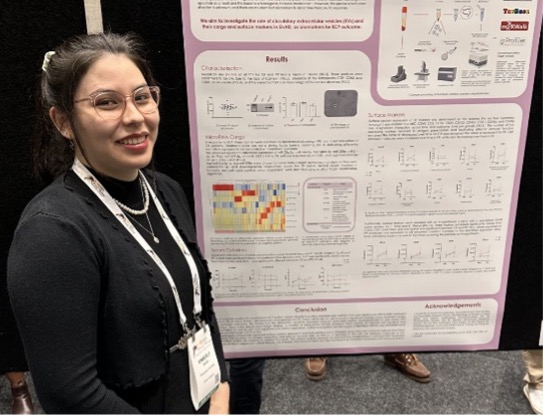
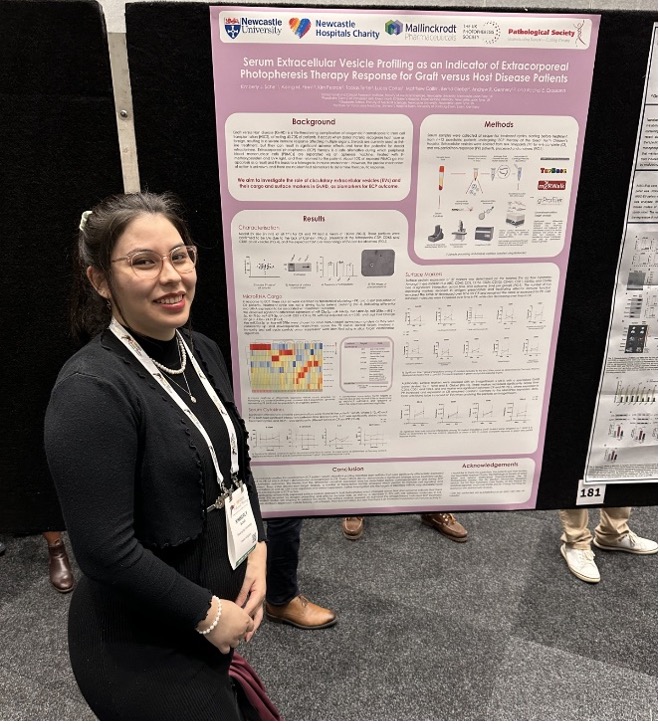
I was given the opportunity to present my work ‘Serum Extracellular Vesicle Profiling as an Indicator of Extracorporeal Photopheresis Therapy Response for Graft versus Host Disease Patients’ in the form of a short oral presentation as well as a poster. I received interest in my work concerning the techniques I used and the disease I study, as it is currently not well researched in the field of EVs, which allowed me to network with peers as well as experts in the field such as Professor Rienk Nieuwland.

I would like to express my gratitude for the support provided by the Newcastle University Faculty of Medical Science Travel Bursary Fund and the Pathological Society of Great Britain and Ireland in the form of a Travel and Conference Bursary which allowed me travel to Australia for the meeting.
Attending ISEV was an invaluable experience, which has inspired me scientifically and allowed me to connect with other scientists with whom potential future collaborations can be formed.

 The UK Photopheresis Society